
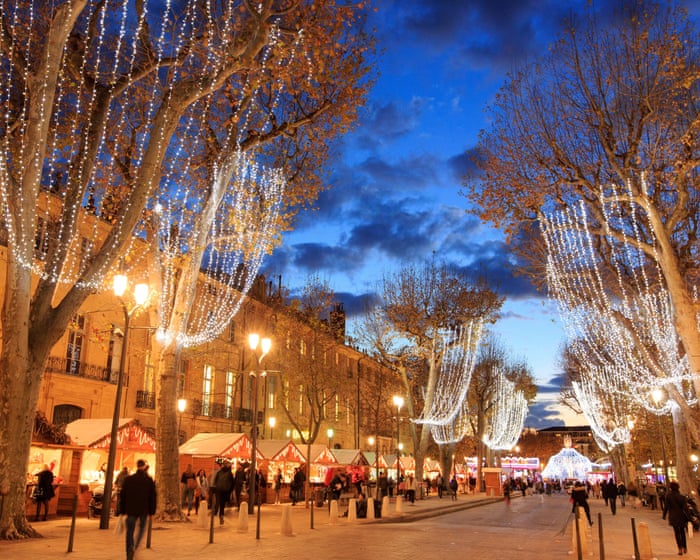
Famous for its fabulous fruit and vegetable markets, Aix-en-Provence extends its stalls in winter to include les treize desserts de Noël, the 13 desserts of a traditional Provençal Christmas. I buy almonds (which represent the Carmelites), dried figs (Franciscans), walnuts (Augustinians) and raisins (Dominicans) from the Place Richelme market. Then I queue up in the Place des Prêcheurs for oreillettes (sweet, ear-shaped wafers), gingerbread, and white and black nougat (representing good and evil). Calissons d’Aix, the city’s celebrated, lozenge-shaped sweets, come from the smart Brémond or Le Roy René confiseries nearby.
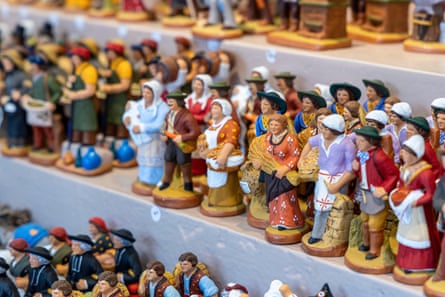
These desserts are laid out on tables in Provençal homes for the Christmas period interspersed with santons (tiny clay figurines), which are sold at Aix’s Foire aux Santons from mid-November. Also displayed alongside the usual Nativity figures in the churches and tourist office, these feature hundreds of Provençal characters including bakers, wet nurses, beekeepers, a pétanque player and the artist Paul Cézanne, who was born in the city, all grimacing to reflect the drudgery of daily life. In January there is even a nativity play, La Pastorale Maurel, at Aix’s Théâtre du Jeu de Paume, with humans playing the still-grimacing santons.
Cézanne was a schoolfriend of Émile Zola, whose father designed a dam (Barrage Zola) to the east of Aix, which is a great hiking destination during winter when the air is crisp, the sky deep blue and the shadows long. Cézanne’s studio, a short walk north of the cathedral, is closed until July but you can follow in his footsteps on a trail up to the Jardin des peintres, where he painted Mont Sainte-Victoire.
Otherwise, the city’s best art experiences this winter are the Henri Cartier-Bresson exhibition at the 18th-century mansion Hôtel de Caumont (until 21 March 2027), and the Musée Granet, which has Paul McCartney’s rediscovered photographs documenting the Beatles meteoric rise to fame in 1963-64 (until 3 Jan 2027).
From early December, lines of wooden chalets are constructed beneath the plane trees of the Cours Mirabeau, Aix’s most elegant avenue. Café Le Grillon halfway down the Cours is perfect for people watching (and their dogs in coats and boots).
Down a slightly run-down alley (very un-Aix) is one of my favourite restaurants, Drôle d’Endroit. It’s always packed, has an arty, factory-canteen vibe and serves cheese and charcuterie boards to share, and dishes such as roast figs with smoked duck, and a ratatouille with almond crumble.
As the Mistral wind brushes through the city in winter, head for the Fontaine Moussue (the mossy fountain) outside Cafe Le Grillon. Fed by thermal springs, the waters of the fountain have been warming up cold hands for more than 350 years.
Where to stay
For a genteel Aixoise experience, try Hotel les Quatre Dauphins (doubles from €115).